
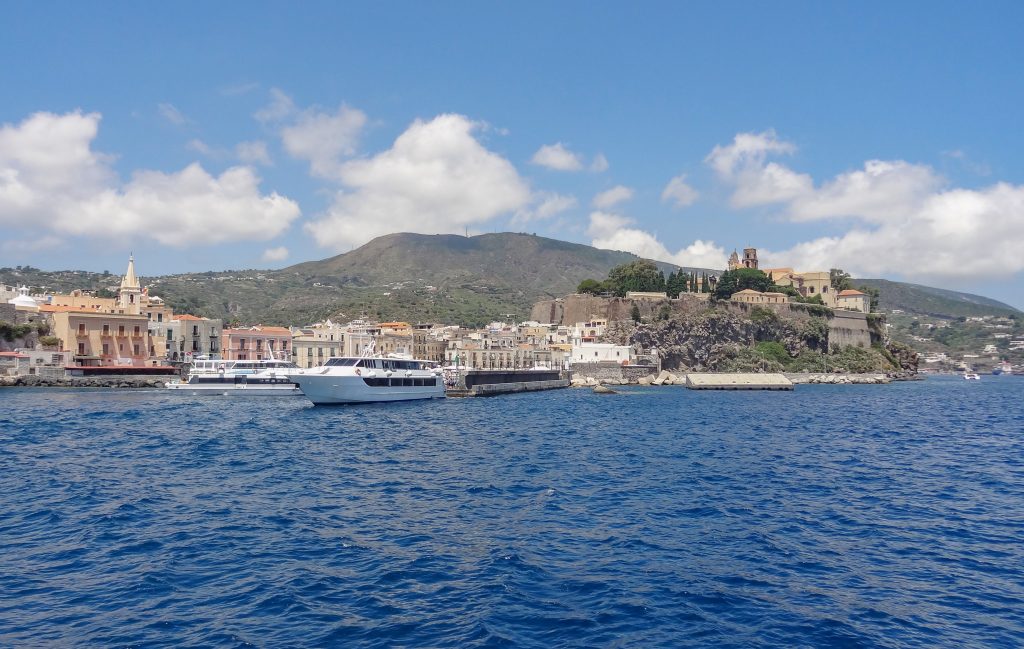
Visit Lipari Archaeological Museum to explore millennia of history: admire prehistoric finds, Greek and Roman ceramics, and displays that bring life in the Aeolian archipelago vividly into focus.
The Museum Setting: Lipari Castle
Inside Lipari Castle, you will discover collections spanning thousands of years, with showcases arranged by chronological area and artefacts that help explain the island’s evolution. Follow an itinerary that highlights ceramic production, metallurgy and Mediterranean connections.
As you climb the towers and cross the courtyards, you will see how the fortified architecture interacts with the displays. The choice of exhibition rooms and the museum layout are designed to guide your historical and landscape-based understanding of the island.
The Acropolis as a Millennia-Old Centre of Power
On the acropolis, you will see the remains of temples, dwellings and fortifications that testify to a long continuity of power and sacred significance. You can reconstruct how local authority was shaped by the trade and cultural networks of the Mediterranean.
Through the ceramics, tools and burials on display, you can trace social and ritual transformations, observing how the acropolis remained a political and symbolic focal point for centuries.
The Scientific Legacy of Luigi Bernabò Brea and Madeleine Cavalier
Thanks to the excavations and publications of Bernabò Brea and Cavalier, we now have a detailed stratigraphic picture of the archipelago. Their methodological approach brought rigour to discoveries and cataloguing.
Careful studies of stratigraphy and context have enabled visitors and scholars alike to interpret settlements, trade and cultural contacts with precision, offering interpretative keys that remain fundamental for future research.
The Neolithic Period and the Obsidian Trade
During the Neolithic period, obsidian became a strategic resource: tools and points circulated between islands and coastlines, creating trade networks that transformed local economies. You can find further information on visits and exhibits at the Luigi Bernabò Brea Archaeological Museum of Lipari.
In the obsidian trade, you can sense the dynamics of specialisation: some communities exploited the sources, while others became centres of exchange, altering social organisation and funerary rituals.
The “Black Gold” of the Aeolian Islands and Its Spread Across the Mediterranean
This obsidian, nicknamed the Aeolian Islands’ “black gold”, has been found in distant contexts, evidence of the breadth of maritime routes and the relationships linking island and mainland populations.
The First Settlements and the Evolution of Material Culture
By examining ceramics, dwelling structures and stone tools, you can reconstruct the growing complexity of settlements, from isolated huts to more stable and organised communities.
Stratigraphic analyses and dating also allow you to follow the technological transformations and cultural exchanges that led to the formation of resilient island communities.
The Bronze Age and the Ausonian Civilisation
As you visit the rooms, you will notice how materials and grave goods reveal a transition towards more complex forms of organisation. You will recognise signs of specialised production and maritime exchange networks linking the islands to the central Mediterranean.
By observing the finds, you will understand the Ausonian influence on funerary practices and metalworking technologies, elements that helped define island identities during a period of intense cultural contact.
The Settlements of the Milazzese Culture and Mycenaean Influence
On cliffs and in inland valleys, traces of Milazzese villages reveal environmental adaptation: you will see remains of habitable structures, silos and signs of recurring spatial organisation.
Evidence of interaction with the Mycenaean world is visible in imported materials and decorative styles. Through typological comparisons and stratigraphic contexts, you can reconstruct routes of exchange and cultural assimilation.
Social and Architectural Transformations on the Islands
As communities evolved, you will notice the emergence of reinforced spaces and architecture reflecting new hierarchies and control over coastal resources, signs of a more complex social order.
Through the analysis of building phases and structural alterations, you can follow how techniques developed and how settlements were organised to meet defensive and productive needs.
Thanks to chronological data and comparisons between materials, you gain a detailed view of the cycles of growth, crisis and social reorganisation that shaped island identity in the Late Bronze Age.
Greek and Roman Lipàra
Exploring the island’s archaeological layers, you will notice the stratification of different presences: public and private buildings, ceramics and coins attest to the gradual integration of Greek models and Roman practices.
As you continue, you can see how political changes influenced the local economy, trade network and architectural choices, while still preserving distinctive Liparian elements.
Urban Planning and Daily Life in the Ancient Colony
Paving, foundations and the remains of workshops allow you to reconstruct the urban layout: streets, squares and insulae organised around trade and domestic life.
Aqueducts, cisterns and collection systems show why water supply and infrastructure must be considered central to understanding the daily routine of the inhabitants.
The Grave Goods of the Contrada Diana Necropolis
Finds from the necropolis speak of funerary practices: pottery, fibulae and weapons reveal information about the status, age and social identity of the deceased.
Decorated pottery and ornamental objects allow you to reconstruct cultural connections and exchange networks linking Lipàra with the Tyrrhenian and Ionian coasts.
Details of burial methods and votive offerings provide useful interpretative keys for distinguishing family rituals from public customs, and for classifying chronologies and cultural influences.
The Theatre Pavilion: Masks and Terracotta
In the Theatre Pavilion, you move among display cases and educational panels that connect masks, fragments and decorative terracotta pieces with the performative context of antiquity. Each object reveals theatrical practices, social roles and ceramic techniques in the Aeolian Islands.
You will admire the care of the display, which highlights distortions, traces of pigment and functional holes, helping you understand not only the aesthetics but also the practical use of masks and scenic elements in performances.
The World’s Largest Collection of Greek Masks
Here you will find a sequence of masks which, through their typological variety and state of preservation, allows visitors to compare tragic, comic and symbolic faces. Precise captions help you follow iconographic evolution and regional variations.
The Artistic and Documentary Value of the Theatrical Finds
You will see how the masks and terracotta pieces are precious visual sources: they reveal modelling techniques, iconographic styles and references to performative practices, enabling you to reconstruct aspects of ancient theatrical production.
On closer inspection, you will find information on stratigraphic dating, typological comparisons and conservation studies that transform each find into a document for art-historical research. This allows you to assess both the aesthetic independence and the social function of the objects on display.
Underwater Archaeology: Treasures from the Seabed
Alongside land-based finds, the museum takes you beneath the waves with recovered objects and explanations of the underwater investigation techniques that have revealed ancient cargoes and vessels.
Here you will find videos, models and interactive panels showing how wrecks settle on the seabed and how scholars reconstruct routes and chronologies.
The Wrecks of the Aeolian Islands and Ancient Trade Routes
Moving through maps and artefacts, you can follow ancient maritime routes and recognise the types of ships that sailed the Tyrrhenian Sea around the islands.
By analysing the distribution of materials and the origins of ceramics, you become aware of the commercial connections between the Aeolian Islands, Sicily and the eastern Mediterranean.
Recovery and Conservation of Large Amphora Cargoes
Thanks to the exhibition reconstructions, you can observe the recovery phases: underwater surveying, controlled lifting and immediate measures to prevent deterioration.
You then follow the protocols for desalination, consolidation and diagnostic study, which transform fragile cargoes into stabilised artefacts for research.
Finally, by exploring the techniques in greater depth, you discover how freshwater baths, polyethylene glycol treatments, monitoring and CT scans reveal the work of conservators and the story told by each amphora.
Lipari Archaeological Museum: A Journey Through History
Visit Lipari Archaeological Museum to follow millennia of Aeolian history and civilisation. Here you can see finds from prehistory to the Roman period, including ceramics, tombs and models that reconstruct the ancient landscape. Clear and well-documented displays guide you with scientific rigour; when you leave, you will better understand the strategic and cultural importance of the Aeolian Islands in the Mediterranean.